The People's Land Map
An investigation into the state of Cape Town public land
Claims vs reality
Parcels of vacant or unused public land in Cape town
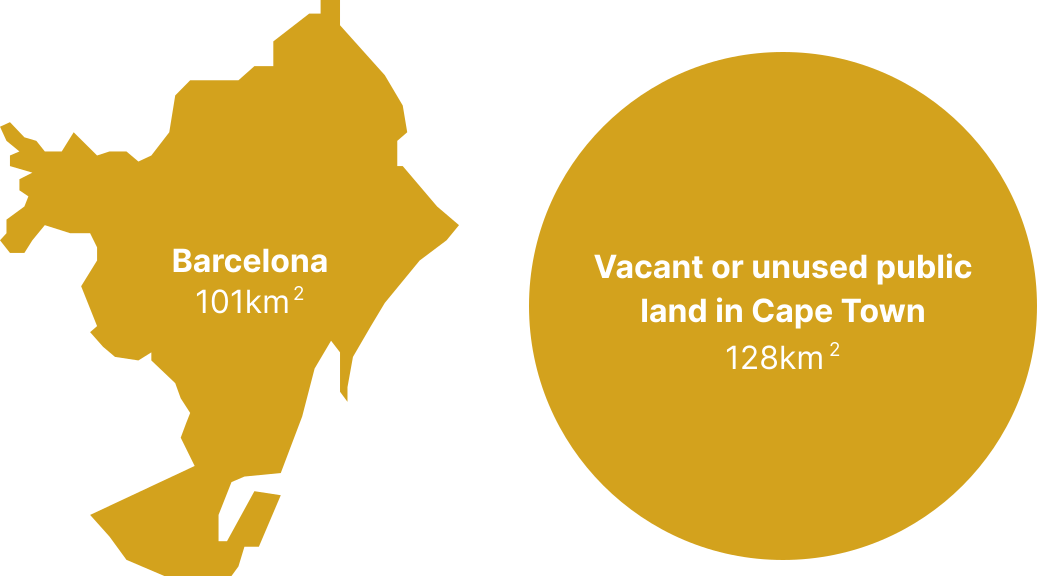
Total size of vacant or unused public land in Cape Town
All three spheres of government claim that there is a shortage of public land to build well-located affordable housing, but is this true? This map, which was manually developed over a number of years, clearly demonstrates that there is more than enough publicly owned land available to help address our housing backlog and desegregate our city.
Cape Town is an apartheid city
... the enduring legacy of colonialism apartheid, combined with a highly exclusive property market means that Cape Town is perhaps the most racially segregated city anywhere on earth.
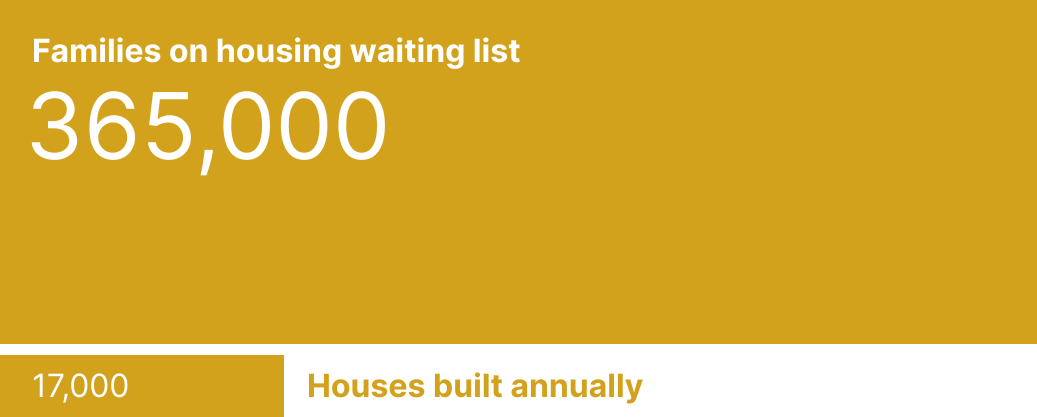
At least 365,000 families are on the housing waiting list in Cape Town with many more people being forced to live in unsafe, inadequate homes that are far from schools, hospitals, jobs and other crucial services. At the same time, the enduring legacy of colonialism apartheid, combined with a highly exclusive property market means that Cape Town is perhaps the most racially segregated city anywhere on earth. Explore how Cape Town is segregated by race, income and language here.
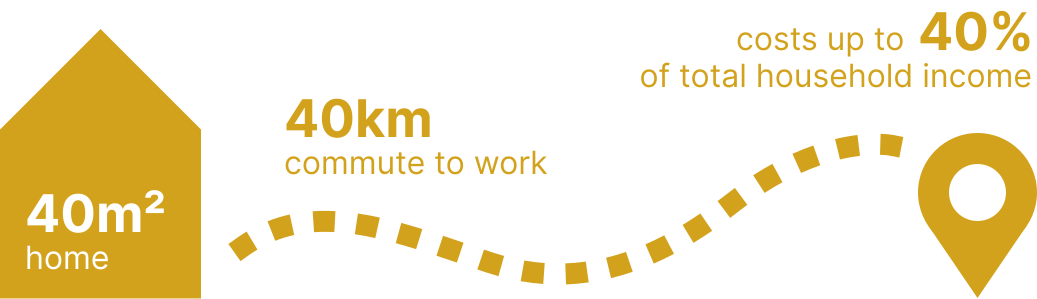
Many families live in a 40m² house, situated 40km from work, and with transport costing up to 40% of their household income. Our housing crisis is getting worse every year, and the easiest way to fight it is to use public land for the public good!
Public land is the best tool we have to make Cape Town more just
Number of families on the housing waiting list
Public land is publicly owned - this means it belongs to all of us. The role of the government is to use this land in the best interest of the people. However, there has been a failure to use public land in an equitable, efficient or sustainable manner. All three spheres of government own considerable land in Cape Town, but none of them are properly maximising its true potential to transform the city.
Public land is publicly owned - this means it belongs to all of us. The role of the government is to use this land in the best interest of the people.
For instance, a joint civil society submission to the presidency, building on decades of activism from a diverse range of groups, has demonstrated that up to 67,000 homes could be built on the nationally owned Ysterplaat, Wingfield and Youngsfield Military Bases alone.
Take a look and make up your own mind about whether the state at all levels is doing enough with its well-located public land to transform Cape Town into a more just and equal city for all.
Public land ownership. How much, how large and how valuable?
The City of Cape Town owns the most vacant and underutilised public land in the municipality at 67,558,651m2 - this is the same size as roughly 9,500 soccer fields!
The Western Cape Provincial Government and national government each own roughly 20,000,000m2 of vacant and underutilised public land in Cape Town - this is the same size as roughly 1300 Grand Parades!
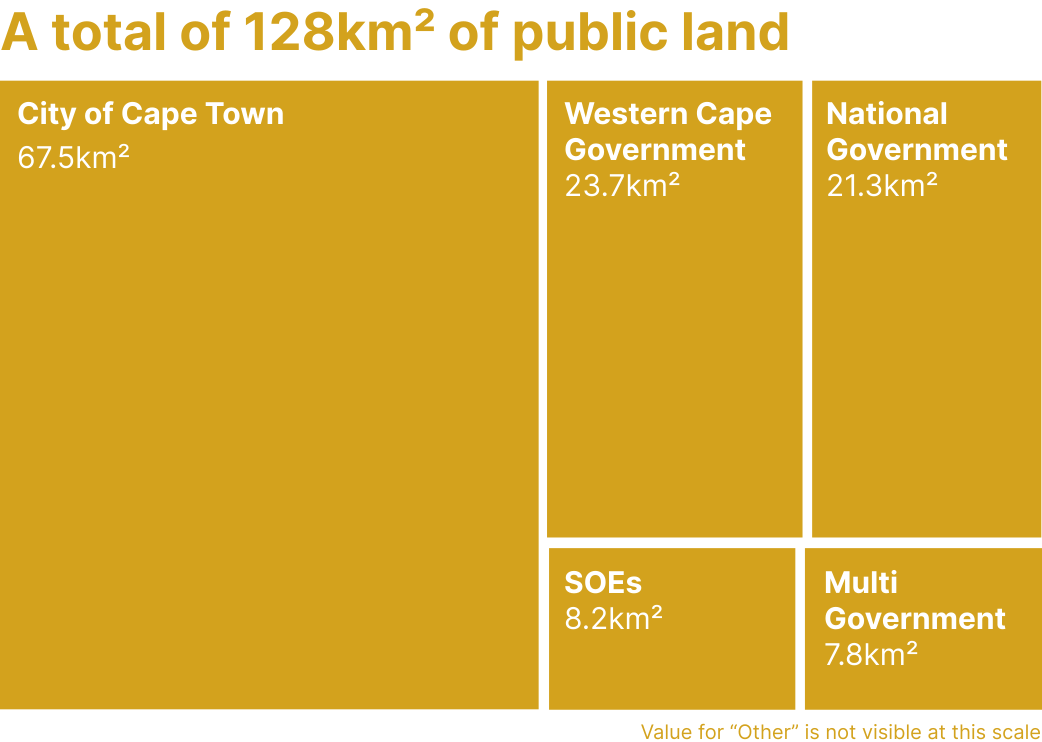
Combined, all spheres of government own at least 128,723,055m2 of vacant or underutilised land in Cape Town - this is roughly the same size as the entire country of Lichtenstein!
On average, land parcels owned by the national government are much larger than those owned by the City of Cape Town or Western Cape Provincial Government.
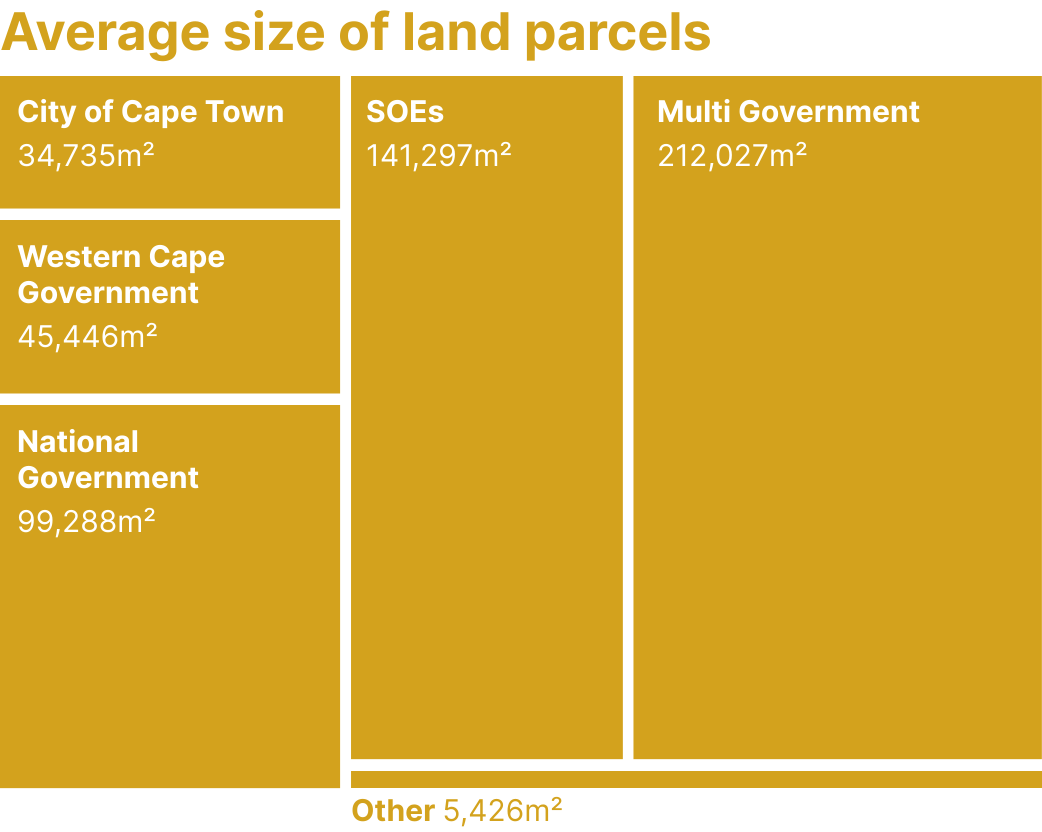
Interestingly, sites owned by State Owned Enterprises (SOEs) and multiple spheres of government are even bigger than those owned by the national government. The average size of land parcels owned by SOEs is 141,297m2 and the average size of land parcels owned by multiple spheres of government is 212,027m2. This land belongs to the public and should be used to benefit all of us!
Of the 5 largest land parcels included in the map, one is owned by the Province, one is owned by the City, one is owned by national government, one is owned by Airports Company South Africa (ACSA), and one is co-owned by the Province and national government.
There are at least 2787 parcels of vacant and underutilised public land that we could find
The City owns 1945 parcels of vacant and underutilised land, the Province owns 522, national government owns 215, SOEs own 58 and 37 parcels are owned by multiple spheres.
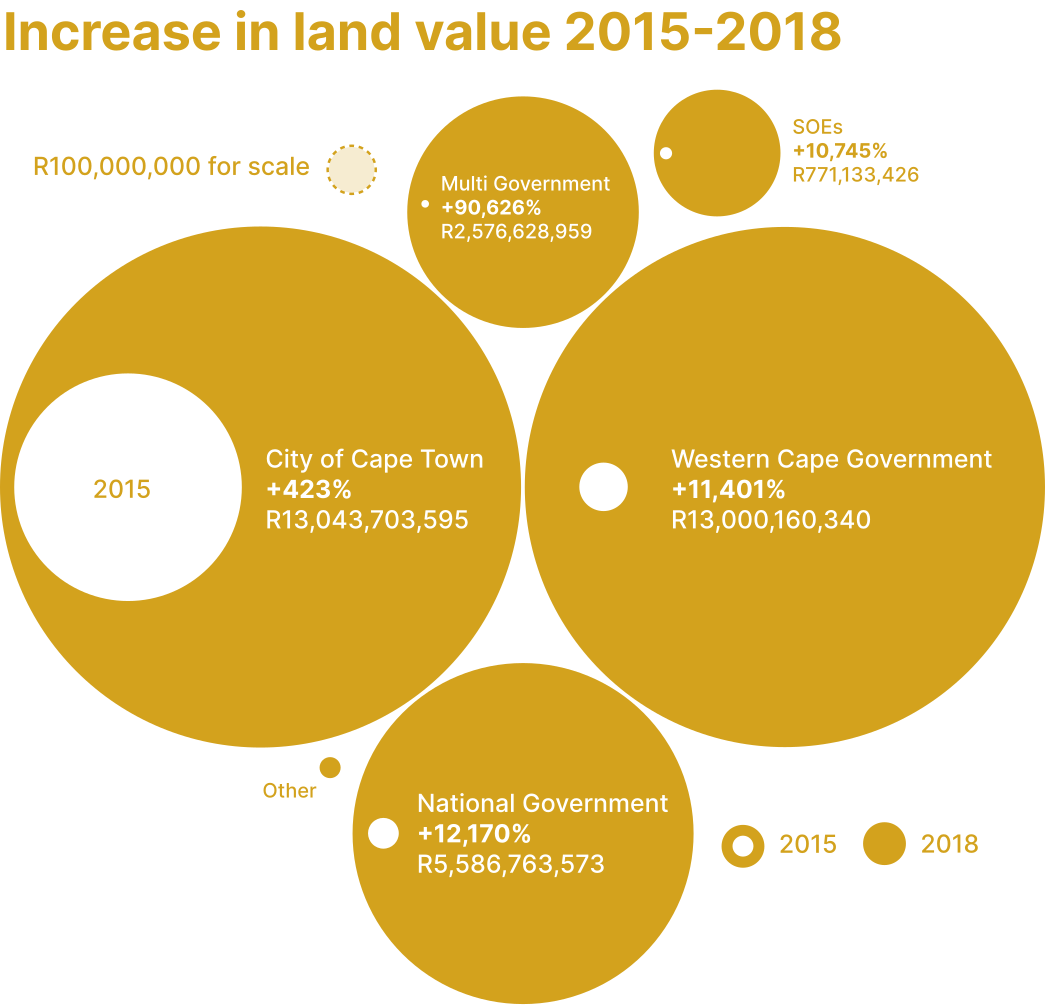
The government severely underestimates the value of land that it owns. More than 300 parcels of public land are formally recorded as having a value of R0, while more than 1,000 parcels of public land are valued at R1,000. Even then, the total value of public land recorded in this map is just under R35 billion! This is the same amount as the annual housing budget for the whole of South Africa!
An overwhelming reluctance to use well located public land for affordable housing
Despite the abundance of available public land, we have seen very few well-located land parcels being committed for affordable housing. Progress has largely been painfully slow on the few commitments that have been secured and some projects seem to have stopped progressing altogether. While the City of Cape Town has made far more commitments than the provincial or national governments, all three spheres of government are failing to act with the necessary urgency. As a result, our housing crisis grows in scale and intensity every year. Scroll down to learn more about some of the public commitments that have been made and where progress currently stands.
When well-located public land is committed for affordable housing, it takes too long or never happens.
The housing and segregation crisis in Cape Town is urgent, with more people forced to live in terrible conditions everyday. The few commitments that the state has made to develop well-located public land for affordable housing have not been delivered with the priority and speed that the situation demands. For example, Salt River Market was identified by City officials as early as 2008, but 15 years later the project has not broken ground.
Salt River Market was identified by City officials as early as 2008, but 15 years later the project has not broken ground.
Cape Town's Affordable Housing Timeline
Tafelberg
Politicians from the Province and City stated multiple times that the Tafelberg should be used for affordable housing.
Maitland Mews
City released Maitland Mews site for affordable housing. The initial attempt to develop the site subsequently failed.
Salt River Market & Pickwick Street
City identified Salt River Market, Pine Road and Pickwick Street for affordable housing development
Athlone Power Station
City commissioned a pre-feasibility study for 4 development scenarios for Athlone Power Station including mixed use and mixed income housing
Founder’s Garden
Province indicated intention to redevelop Founder’s Garden in Cape Town Central City Regeneration Programme
Conradie Hospital
Province launched ‘Better Living Model’ with the announcement of the redevelopment of the old Conradie Hospital
Foreshore Freeway Project
City launched Foreshore Freeway Project
Tafelberg
Province published a feasibility report that proposed mixed-use development on Tafelberg
Goodwood Station Social Housing project
City, Province, National, Social Housing Regulatory Authority (SHRA) and Passenger Rail Agency of South Africa (PRASA) initiate Goodwood Station Social Housing project
Tafelberg site sold to private buyer
Province announced that it was going to sell the Tafelberg site to a private buyer rather than develop it for affordable housing. On the same day it announced the redevelopment of Somerset Precinct and old Woodstock Hospital (now occupied as Cissie Gool House) including affordable housing.
Multiple affordable housing sites released
City released Woodstock, Salt River and Inner City Precinct Affordable Housing Prospectus which committed 11 parcels of well-located public land for affordable housing. The sites identified were Upper Canterbury Road, Fruit and Veg site, New Market Street, 2 pieces of land on Pickwick Road, Salt River Market, the old Woodstock Hospital (now occupied as Cissie Goold House), Pine Road, Dillon Lane, James Street and Woodstock Hospital Park. Importantly, some of these sites had previously been committed for affordable housing. Read more about why only one of these projects is done and what we think could help to see affordable homes on the ground in Spatial Justice Delayed: Understanding Obstacles to social and transitional housing in central Cape Town
Athlone Power Station
City included Athlone Power Station redevelopment in it’s Municipal Spatial Development Framework.
Parow Precincts
City announced it would develop a number of parcels of public land in Parow called Parow Precincts.
Green Point Bowling Green
City confirmed in a letter that it intended to redevelop Green Point Bowling Green, including affordable housing.
Foreshore Freeway project cancelled
City announced that the Foreshore Freeway project had been cancelled due to legal issues in the tender process
Moray Place
Province stated in Tafelberg court papers that Moray Place was in the housing pipeline.
Pickwick Transitional Housing complete
Pickwick Transitional Housing was completed and occupied by 19 families.
Founder’s Garden
Province confirmed the inclusion of affordable housing in the redevelopment of Founder’s Garden.
Mowbray & Rondebosch Golf Clubs
City identified King David Mowbray Golf Club and Rondebosch Golf Club for redevelopment including affordable housing.
Conradie Park handover
The first 66 social housing apartments were handed over to families at Conradie Park, while the development of the rest of the site continues.
ERF 81 & Wingfield Military Base
National Department of Public works indicated in a letter to civil society that a portion of Erf 81 will be made available for human settlements and that a portion of Wingfield Military Base will be released for human settlements
Maitland Mews project is completed
Land committed to affordable housing
.svg)
What can the government do
This map shows us that the state is failing to efficiently redistribute well-located public land for affordable housing. There are many existing ways that the government can release public land and develop affordable housing. Four of the main mechanisms for releasing land for affordable housing are:
- Selling, leasing or donating land to Social Housing Institutions and the private sector
- Interstate transfer
- Land acquisition
- Expropriation
Click here to learn more about how land can be released for affordable housing. There is no excuse for the lack of progress!
What can you do?
Public land is your land. What can you do to make sure that it is used for the benefit of all of us?
- Spread the word: share with other people and post on social media
- Join or support an existing housing movement
- Get organised with your friends and neighbours
- Place pressure on the state to urgently follow through on existing commitments for well-located affordable housing by writing to public representatives. For example, you could put pressure on your ward councillor to use public land in your ward for public benefit. Find your ward councillor here
- You can see how much public land exists in your neighbourhood and start a campaign for it to be used in a more socially responsive way depending on what your area needs - from affordable housing to public green space to clinics. If you are interested to learn more about the public land in your area, contact us at contact@nu.org.za
- Follow Ndifuna Ukwazi and Reclaim the City on social media to stay in touch with how to get involved
Every action you take makes a difference - join the fight for affordable housing!
Why the map was made
We say public land means public transparency. However, despite our best efforts to access information on public land through multiple strategies, our requests for information have been consistently denied. We also learnt through ongoing engagements with officials and politicians that even within the state (such as the City of Cape Town) there is no clear picture of the extent, use and potential of public land in our city. We were concerned that neither the public nor the state actually know the full extent of publicly owned land that could be used for affordable housing. There is also a lack of clarity about what commitments have been secured and what progress has been made. This undermines the ability of public land to be used in a coordinated and just way.
It became necessary for us to conduct our own audit of vacant and underutilised public land in order to do evidence based advocacy work. Taking inspiration from the global counter-mapping movement, we developed our own method for manually mapping vacant and underutilised land owned by the government in Cape Town.
See a collection of counter-mapping projects from around the world at This Is Not An Atlas.
This map is not a tool to encourage speculation by the private sector or land occupations, but is rather a tool to promote accountability and stimulate the public imagination. Many other governments around the world provide the public with transparent access to this information.
We hope this map helps you to see vacant and underutilised public land as spaces for opportunity, as focus points of community organising and civic engagement to make our city better for all.
How the map was made
While not entirely accurate, this map is based on the most accurate publically available data. The map aims to provide an overall picture of the vast amount of vacant and underutilised public land at a moment in time as this picture is constantly changing. The data collection for this map was done between 2018 and 2022.
For a full description of how we created the map, see our detailed methodology.
Legal
Ndifuna Ukwazi is a non-profit activist organisation and law centre that combines research, community organising and litigation in campaigns to advance urban land justice in Cape Town. Our primary mission is to expand and protect access to affordable housing towards building a more just and equal city. We have created this map with the aim of raising awareness around the amount of available public land in Cape Town, and to invite the public to participate in conceptualising how these underutilised and vacant spaces can and should be used differently to build a more just future. This map is a challenge to the national, provincial and local government’s lack of transparency around public land, poor public participation around decisions on public land, and the way in which it traditionally engages with issues of land and housing.
While every effort is made to ensure the accuracy of information, Ndifuna Ukwazi makes no warranties as to the correctness of the information supplied. The methodology used for developing the public land map is more fully described at (insert link to the more detailed document about methodology). The public land map does not constitute professional advice. Ndifuna Ukwazi and/or the members of its board, its donors its staff and its website service provider (hereinafter collectively referred to as “Ndifuna Ukwazi”) shall not be liable for any improper or incorrect use of the information described and/or contained herein. Ndifuna Ukwazi assumes no responsibility for any person's use of information and such person relying on the information described and/or contained herein does so entirely at their own risk.
Ndifuna Ukwazi will not be liable for any claims whatsoever, howsoever arising, in connection to, or out of the use of, or upon reliance on information described and/or contained herein, whether or not such claim is attributable to any negligent act or omission on the part of Ndifuna Ukwazi.
Methodology
Due to the lack of publicly available information on publicly owned land within the Cape Town Municipality, it became necessary for us to develop a methodology to build a database ourselves. The aim of this database was to more fully understand how much public land each sphere of government owns that is vacant and underutilised. The idea is that by demonstrating how much public land is available for social good such as the development of housing, all three spheres of government will no longer be able to perpetuate the myth that there is a shortage of land that can be used to address the housing crisis. While not entirely accurate, this map is based on the most accurate publically available data. The map aims to provide an overall picture of the vast amount of vacant and underutilised public land at a moment in time. The data collection for this map was done between 2018 and 2022.
This methodology entailed a desktop study that used a visual assessment of publicly available aerial imagery of land that appears to be vacant or underutilised. Once seemingly vacant or underutilised land was identified, we used the City of Cape Town's online tools to establish ownership and further details of individual sites. Wherever possible we made use of the City of Cape Town’s own online tools to identify property owners on the understanding that as the municipality, they should have the most accurate data on public land within their boundaries. This also means that all data used already exists in the public realm.
Public land is publicly owned and by extension belongs to all of us. However, despite our best efforts to access information on public land through formal requests to the City of Cape Town, this data is generally inaccessible to the general public. Either the data is located in different formats across multiple digital platforms or the ownership information is not readily available. We aim to bring public land into the public domain. This map is not a tool to encourage land occupations or speculation by the private sector, but is rather a tool to promote accountability and stimulate the public imagination.
Layer 1: Vacant and Underutilised public land
Step 1: Visually identifying vacant or underutilised sites
Firstly, as a proxy for vacant and underutilised land we would do a systematic visual search, area by area, on both Google Maps and the City of Cape Town’s City Map and Zoning Viewer for sites that appear from a birds eye view to be vacant or underutilised. We made use of a list of suburbs and used roads and other physical structuring elements of each area to ensure that areas were visually surveyed meticulously. The City Map and Zoning Viewer is publically available through the City of Cape Town’s Planning Portal and provides spatial details across the metro. For the City’s own description of the tool see: here.
On the City Map and Zoning Viewer we used the latest aerial photography layer, which was from 2018 when this process began. Google Maps has updated their aerial photography over the years that we have been collecting this data, with the aerial photography being from 2021 at the time of launching this map. Because land ownership changes over time and public land will continue to be bought and sold once we launch this map, this map provides a look into public land ownership during the period of time that we have been creating this map, i.e. 2018 - 2022.
Determining what is ‘vacant or underutilised’ from aerial photography alone is a subjective assessment of a piece of land. A clear limitation of this approach is that these sites have not been ground-checked. Furthermore no analysis of government planning documents have been done to assess whether any specific site identified is currently leased out by government or has been earmarked or reserved by government for specific use and/or delivery. Very limited analysis has been done on the commitment of well-located sites for affordable housing. This means that we have collected this data on the basis of what appears vacant and underutilised from a bird's eye perspective to provide a city-wide overview of the extent of public land that could be used better. It would be necessary for any map-user to conduct their own ground level assessment and assessment of government planning documents should they wish to get a more complete, accurate and deeper understanding of any specific site.
Please note that for capacity reasons the areas of Parow, Belhar, Milnerton, Elsies River, Kuils River, Delft and Blouberg have only been partially mapped. This means that the map provides a conservative estimate of public land. This is only the first iteration of the map, and we hope to more fully survey these areas in future versions.
It is also worth noting that the current version of the map does not attribute environmentally sensitive land parcels, and that this is another reason why some of the land on the map may not be suitable for development. We have endeavoured to avoid including land parcels that are clearly environmentally sensitive or inappropriate for development.
The criteria used to identify vacant and underutilised land is as follows:
1. Visual assessment of land with unrealised potential:
We looked visually on the aerial photography of an area for sites that were not at all, or not entirely built up. We have included parking lots, open land, golf courses, schools with large grounds and other sports grounds in this assessment.
This does not mean that we think that affordable housing should be built on all available open or green space across the city. Rather, when looked at holistically it is clear that the state is not making use of the well-located land that it owns in an equitable and efficient way that balances the pressing demand for affordable housing with the need for open green space and uses for public good. The need to look not just to empty but also to partially used public land is in line with a growing need for underutilised public land that is used for schools, parks and more to be intensified and used to its full potential. For instance, the African Centre for Cities has called for portions of neglected and underutilised school grounds to be used for infill development of affordable housing as a way of densifying, activating an increasing safety of the area while providing inclusive housing opportunities.
As it is near impossible to establish from aerial imagery whether a building, rather than a piece of land, is vacant or underutilised, this means that there are many sites that in reality stand vacant and underutilised that are not included in this database, making it a conservative estimate.
2. Size:
We have only included sites that are over roughly 1000m2 that appear from the aerial imagery to be vacant or underutilised. This is due to the fact that it is highly unlikely that it would be feasible to develop affordable housing on a site smaller than this. This means that this map does not capture all vacant and underutilised public land and is therefore a conservative estimate.
Step 2: Establishing whether the vacant or underutilised site is publicly owned
Once a site was visually identified as vacant or underutilised, we established whether the land is publicly owned. In order to do this, we referred back to the City of Cape Town’s City Map and Zoning Viewer to establish the erf number and/or address. We used this information to search for the ownership of the site by searching the erf number or address on the latest publicly available General Valuations Roll, from 2018. This is used as it is the most recent record of municipal valuations for Cape Town that is publicly available. Where we cannot establish ownership on the 2018 General Valuations Roll due to missing or incomplete data, we have in some instances used the 2015 General Valuations Roll or an online property platform to confirm ownership.
Step 3: Recording publicly owned vacant or underutilised land
Once we have established that a site is both visually vacant or underutilised and publicly owned, we then record the details of that site in our database. We include in our database additional information from both the City Map and Zoning Viewer and the General Valuations Roll including the size, zoning and value of the site. We have often had to group multiple erven together into one piece of land when they could functionally form an individual site. Ideally, the City would be consolidating these parcels of land itself in order to maximise their potential.
Step 4: Tracking progress of mapping
As a final step in the data collection process, we have created a Google Map to track the public land we’ve captured as we go. The primary purpose of this was to increase accuracy by helping us to gauge our progress and make sure we had mapped systematically across the city and had not missed any suburbs or areas. This included capturing sites that were privately owned to ensure efficiency and avoid the re-checking of sites. This step also created a proto-type map that assisted in our imagining and thinking around the final public land map output.
Layer 2: Well-located public land committed for affordable housing
As mentioned above an assessment of government planning documents has not been done as part of this work. However, a layer has been developed on the map which includes notable commitments for affordable housing in well-located areas by various spheres of government. News outlets as well as government documents, speeches and media statements were used to provide the most accurate publicly available information about these commitments including what the commitment was and the status of that commitment.
For instance, for the 11 Woodstock, Salt River and Inner City Precinct Affordable Housing Prospectus Sites announced by the City in 2017, we collected information about the sites and what was planned for them in the City’s Woodstock, Salt River and Inner City Precinct Affordable Housing Prospectus document and since then have used the City’s media statements, public participation processes and public forums to collect information on the progress on the commitments.
The City Map and Zoning Viewer and the General Valuations Roll were used to supplement additional information about the various sites including the size, zoning and value.
Progress on these commitments made after the launch of this map will not be updated. This means that what you are looking at is a moment in time and some additional progress may have been made on these promises by the time you are seeing this.
Creating the online interactive map
In collaboration with OpenUp, Civic Technology & Open Data Specialists, the spatial data of the two layers was then overlaid over a basemap and translated into the online interactive map that you are using today!